

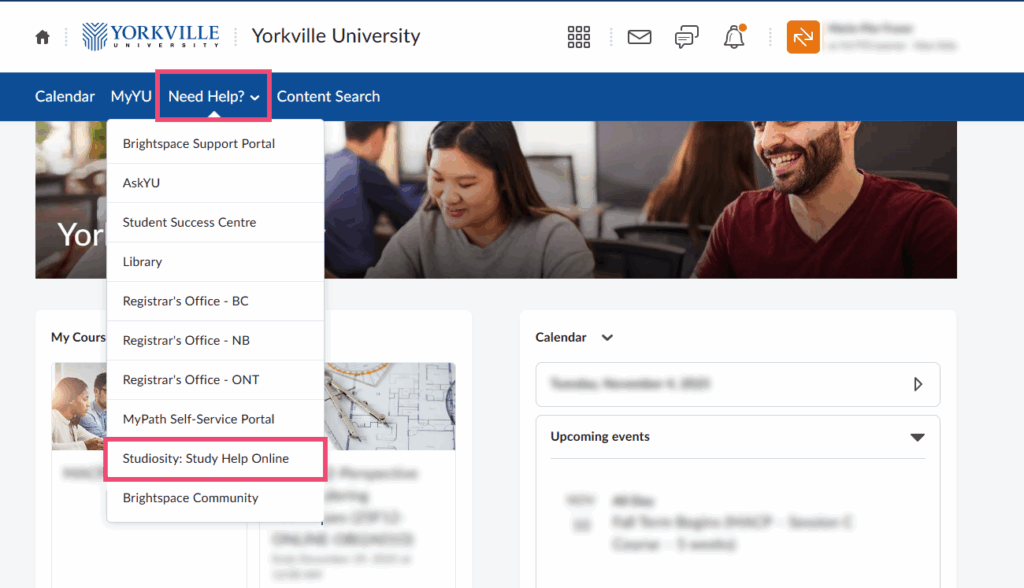
Studiosity provides 24/7 online support for all students, offering help with writing, math, and academic skills.
As a Yorkville University student, you can access specialized AI systems (Writing Feedback+ and Study Assist) and human specialists around the world (Connect Live), for individual, just-in-time feedback and suggestions. All available to you for free as a Yorkville University student!
Studiosity includes three distinct services all accessible through one portal:
Upload your writing and receive AI generated feedback in seconds on critical thinking, language use, structure, spelling and grammar, and source integration. The system displays detailed feedback in a sidebar, using unique colors for each category. You review and interpret the feedback, make your own revisions, and actively engage in the writing process. You can submit unlimited times to Writing Feedback+.
Use this AI powered assistant to start your assignments and improve your study skills. Ask questions anytime, 24/7, from your Studiosity account. There are no limits to how often you can interact with Study Assist.
Connect with a human expert for one-to-one support 24/7! Submit your question, and Studiosity matches you with a specialist in real time. Use Connect Live for English skills such as punctuation, spelling, grammar, sentence structure. You can also get help with math questions and study coaching, including work planning, revision timetables, study tips, and note-taking.
You have six Connect Live sessions every four-month period (January–April, May–August, September–December). Your allocation renews every four months.
Confidentiality Notice: Studiosity may review sessions for quality assurance. Specialists may notify the Student Success Unit if they believe you need additional support beyond what they can provide.
Monday: 9 AM – 8 PM
Tuesday: 9 AM – 8 PM
Wednesday: 9 AM – 8 PM
Thursday: 9 AM – 5 PM
Friday: 9 AM – 4 PM
Saturday: 10 AM – 8 PM (Online Only)
Sunday: 10 AM – 2 PM (Online Only)
Monday to Friday: 10 AM – 3 PM
Here are some reading comprehension strategies that will help non-native English Language students gain a better understanding of course readings.
Rather than focusing on, or worrying about, what you don’t know, strive to draw from information and knowledge you already have. Building on what you currently know can help you establish and strengthen connections between old and new knowledge.
Before you begin to read the material, take a moment to go through the text. For example, the material may contain tables, charts, or even major headings that will give you a general idea of what to expect. This will also give you an idea of what topics or general ideas to consider when reading the material and will help you identify major points.
If you are being asked to read material for an assignment, consider what the assignment is asking you to do. Carefully read through and ensure that you understand the instructions of your assignment and try to identify any questions or ideas that you need to look for when you read the material.
In addition to understanding the reading material, using a dictionary can help you understand the meaning of new words and help you expand your vocabulary. Using these words will allow you to recognize and understand other sentences where the words are used and help you remember the word in your own vocabulary.
Graphs, charts, maps, timelines, and other drawings can help you to organize your information and make it easier to see the connections between ideas.
Determine how much you will read (for example, one section or chapter) at a time and summarize what you know when your finish that bit of reading. Ask yourself if you can give a very short summary of what you have read, focusing on major points and highlighting key words.
Email us to speak to an Accessibility and Accommodations Specialist.
Book a confidential appointment through PHIPA compliant software.
If you are…
• feeling desperate and hopeless
• worried you might hurt yourself, someone else, or commit suicide
• alone with no one to talk to
Please reach out to a Support Hotline in your region immediately for help.
Emergency responders and the 9-1-1 call centres who dispatch them fall within the jurisdiction of provincial, territorial and municipal governments.
Call 9-8-8 for 24-hour crisis support via phone or text. Resources offered for individuals in crisis,
those unsure if they need help, and people worried about someone else.
24-Hour Hotline: 1-855-242-3310
Monday-Friday, 1PM-9PM Eastern: 1-877-330-6366
Connex Ontario 24-hour Helpline: 1-866-531-2600
Free and confidential health services information for individuals experiencing issues with
alcohol and drugs, mental illness, or gambling.
Good2Talk 24-Hour Hotline: 1-866-925-5454 or Text GOOD2TALKON to 686868
Quebec National Crisis Line – All Ages: 1-866-277-3553
Mental Health and Addictions Phone Line: 1-833-553-6983
Alberta Health Services Mental Health Help Line: 1-877-303-2642
Manitoba Suicide Prevention and Support Line: 1-877-435-7170
Addiction and Mental Health Help Line: 1-866-355-5550
Crisis Intervention and Suicide Prevention Centre of BC: 1-800-784-2433
Here2Talk, 24/7: 1-877-857-3397
Mental Health Crisis Line: 1-888-737-4668
NWT All Ages 24/7: 1-800-661-0844
Mental Health and Addictions Crisis Line: 1-888-429-8167
Nunavut Line – All Ages, 24/7: 1-800-265-3333
Saskatchewan Crisis Line – All Ages: 1-306-525-5333
Reach Out Support Line: 1-844-533-3030
988 Suicide and Crisis Lifeline: 9-8-8
Trans LifeLine – U.S.A.: 1-877-565-8860
The Trevor Project Lifeline: 1-866-488-7386
Jeevan Aastha Help Line: 1-800-233-3330
Aasra: 91-9820466726
Lifeline China: 400-821-1215 (10AM-10PM, 365 days a year)
The Samaritans Emotional Support Services: 852-2896-0000